Geotechnical Engineering in North Las Vegas

Together, we solve the challenges of tomorrow.

LEARN MORE →

Most contractors in North Las Vegas learn the hard way that standard soil maps don't work here. The valley floor shifts from dense caliche to loose wash deposits in less than 200 feet. You core one lot and get hardpan. The next one collapses. We've seen foundations re-engineered mid-pour because the geotech report used generic assumptions instead of site-specific data from a soil mechanics study. Our team runs ASTM D1586 SPT borings and lab triaxial tests to give you exact numbers—bearing capacity, settlement magnitude, and shear strength. No guesswork. The Atterberg limits testing tells us exactly how the fine fraction behaves when wet, which matters in a city where flash floods can saturate the ground in minutes.

In the Mojave Desert, a soil mechanics study isn't about finding water—it's about predicting how the ground collapses when the water disappears.
Geotechnical Engineering in North Las Vegas
Technical reference image — North Las Vegas

Our approach and scope

North Las Vegas sits on the northern edge of the Las Vegas Valley, where the groundwater table has dropped over 90 feet since the 1950s due to municipal pumping. That changes everything. Soils that were once saturated are now dry and collapsing. We calibrate every soil mechanics study to this reality. Our lab runs consolidated-undrained triaxial tests on Shelby tube samples to measure effective stress parameters. We also run grain size analysis to classify the material per ASTM D2487—critical when you're working near the Upper Las Vegas Wash and encounter interbedded silts and gravels. For deep foundations near the 215 beltway, we combine SPT data with CPT test profiles to catch thin soft layers that boreholes might miss. Every report includes modulus of subgrade reaction and allowable bearing pressure under both static and seismic load combinations per IBC 2021.

Site-specific factors

A three-story medical office building near Aliante Parkway started showing diagonal cracks in the drywall six months after completion. The original geotech report missed a 4-foot layer of loose silty sand at 9 feet depth. That layer consolidated unevenly under the spread footings. Differential settlement reached 1.2 inches before we were called in. Our soil mechanics study identified the weak zone with continuous sampling and provided revised modulus values for underpinning design. The repair cost the owner $180,000. A second boring and a plate load test at footing elevation would have caught it for under $4,000. The lesson: don't let a low-bid investigation become a structural problem. North Las Vegas soils don't forgive shortcuts.

Need a geotechnical assessment?

Reply within 24h.

Email: info@geotechnicalengineering1.com

Technical data

ParameterTypical value
Standard Penetration Test (SPT) N60Performed per ASTM D1586 at 5-ft intervals
Soil ClassificationUnified Soil Classification System (USCS) per ASTM D2487
Triaxial Shear Strength (CU)Effective cohesion (c') and friction angle (φ') measured
Settlement AnalysisImmediate and consolidation settlement per elastic theory
Bearing CapacityNet allowable under static and seismic (ASCE 7-22 Chap. 11)
Collapse PotentialASTM D5333 for hydrocompactive soils in arid regions
Report TurnaroundFinal PDF with lab data in 5 business days

Complementary services

01

Field Investigation and Sampling

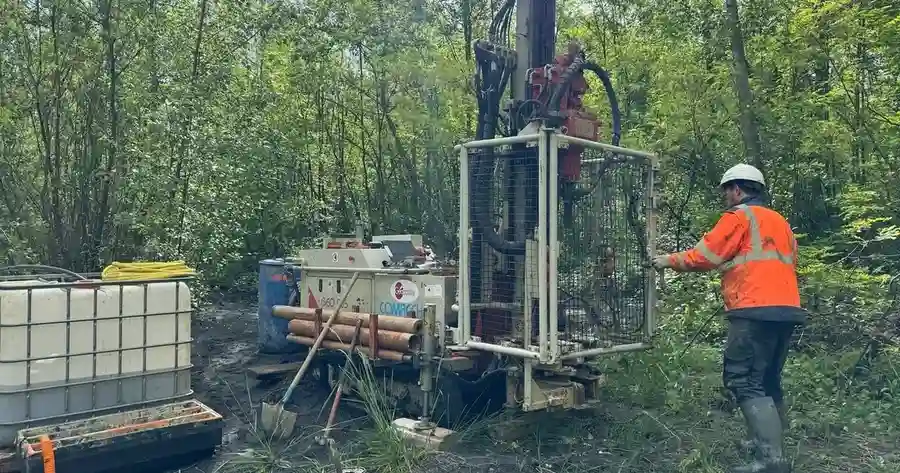
Truck-mounted CME-75 drill rig. Hollow-stem auger borings to 50 feet. SPT sampling at 5-foot intervals. Shelby tube sampling in cohesive layers. Groundwater observation where encountered.

02

Laboratory Testing Program

Moisture content, unit weight, Atterberg limits, grain size distribution, unconfined compression, consolidated-undrained triaxial, and collapse potential per ASTM D5333.

Standards used

IBC 2021 (International Building Code) – Chapter 18 Soils and Foundations, ASCE 7-22 – Minimum Design Loads and Associated Criteria for Buildings and Other Structures, ASTM D1586 – Standard Test Method for Standard Penetration Test (SPT) and Split-Barrel Sampling of Soils, ASTM D2487 – Standard Practice for Classification of Soils for Engineering Purposes (Unified Soil Classification System), ASTM D4767 – Standard Test Method for Consolidated Undrained Triaxial Compression Test for Cohesive Soils

Common questions

How much does a soil mechanics study cost in North Las Vegas?

For a typical single-family residential lot or small commercial parcel in North Las Vegas, a complete soil mechanics study runs between US$3,550 and US$5,630. That includes two borings to 25 feet, SPT sampling, lab classification and shear strength tests, and a stamped report with bearing capacity and settlement recommendations. Larger projects or sites requiring deep borings or specialty tests like collapse potential or triaxial will be quoted based on scope.

How deep do you drill for a soil mechanics study here?

For standard light commercial and residential projects in North Las Vegas, we drill to 25–30 feet below finished grade. If the IBC requires investigation to a depth where the net stress increase is less than 10% of the effective overburden, we extend borings to 50 feet or more. Deep foundations near the Las Vegas Wash may require 60-foot borings to confirm bearing strata continuity.

Do you handle the permit submittal to the City of North Las Vegas?

Yes. Our geotechnical reports are formatted to meet the City of North Las Vegas Building & Fire Safety Department requirements. We include the required checklist, boring location plan, and design parameters in the format the plan reviewers expect. We also respond to review comments at no extra charge during the first round.

What soil problems are common in North Las Vegas?

The three most common geotechnical issues we see are: hydrocompactive (collapsible) soils in the older alluvial fans, caliche layers that vary from soft to rock-hard within a single boring, and loose sands in the washes that can densify under seismic shaking. Our soil mechanics study addresses all three with appropriate lab testing and analysis.
Location and service area

We serve projects in North Las Vegas and surrounding areas.

View larger map