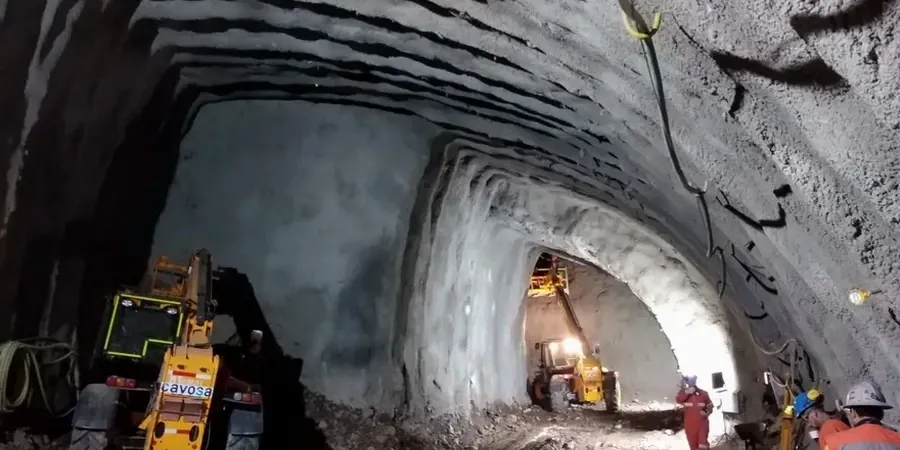
The most common mistake on North Las Vegas tunnel projects happens before the first bucket of soil is moved. Contractors assume the basin fill is uniform. It is not. The upper 30 to 50 feet beneath North Las Vegas consist of interbedded clays, silts, and loose sands deposited by Pleistocene runoff. These layers shift dramatically over short distances. A standard site investigation misses this variability. The result is face instability during excavation. Or worse, surface settlement that damages infrastructure on Losee Road or along the I-15 corridor. The ASCE 7 load combinations for underground structures demand a site-specific soft soil model. Generic assumptions fail here. Our team builds that model using high-frequency sampling and lab testing calibrated to ASTM D2487 classification. Before the TBM advances, the soil behavior must be mapped in detail. This is especially true where the groundwater table in North Las Vegas fluctuates due to seasonal recharge and urban irrigation. We also integrate seismic refraction surveys to map the bedrock interface depth, which can vary 20 feet within a single block. This data feeds directly into the excavation support design.
Tunneling through the Las Vegas Valley's interbedded basin deposits demands a soil model that captures layer pinch-outs. A missed clay seam 18 feet down can change the entire excavation support plan.
Our approach and scope
North Las Vegas sits at approximately 1,960 feet above sea level, on the northern edge of the Las Vegas Valley hydrographic basin. The city's population has surged past 280,000, driving infrastructure expansion into areas with notoriously poor soil. The primary challenge here is not hard rock. It is the compressible, low-strength fine-grained alluvium that collapses when disturbed. Tunnel alignment through this material requires a rigorous geotechnical analysis for soft soil tunnels. We focus on three critical parameters: undrained shear strength, compressibility index, and pore pressure response. Sampling follows ASTM D1586 procedures, with SPT N-values often recording blows below 6 in the upper 15 feet. These numbers signal a high potential for squeezing ground conditions. To address this, we combine the SPT data with
CPT testing to obtain a continuous profile of tip resistance and sleeve friction. This dual approach reduces the uncertainty in settlement predictions. The lab program then applies triaxial CU and UU tests to define the failure envelope. This is not a generic report. It is a tunneling-specific geotechnical model built for North Las Vegas' unique basin stratigraphy. For projects near the Las Vegas Wash, we also assess the liquefaction potential of the saturated sandy lenses, using the Seed & Idriss simplified procedure adapted for local seismicity. The integration of
MASW surveys provides shear wave velocity profiles that are essential for site classification per IBC Chapter 16.
Common questions
What is the typical cost range for a geotechnical analysis for soft soil tunnels in North Las Vegas?
The cost depends on the tunnel length, depth, and the number of borings required. For a typical alignment between 500 and 2,000 linear feet, the geotechnical investigation and analysis package ranges from US$4,350 to US$19,200. This includes field exploration, laboratory testing, and the final geotechnical interpretive report with numerical settlement analysis.
How deep should the borings go for a soft ground tunnel project?
Borings must extend at least 1.5 to 2 times the tunnel diameter below the proposed invert elevation. In North Las Vegas, where basin fill can exceed 1,000 feet, we target a depth that captures the stress bulb of the excavation. If bedrock is shallower, borings should penetrate 10 feet into competent rock to confirm the interface.
Which laboratory tests are essential for soft soil tunneling?
The essential suite includes Atterberg limits, grain size distribution, unconfined compression, and consolidated-undrained triaxial tests with pore pressure measurement. Oedometer consolidation tests are critical for settlement prediction. We also run direct simple shear tests if the alignment crosses liquefiable layers near the Las Vegas Wash.
How long does a soft ground tunnel geotechnical investigation take?
Fieldwork typically takes 2 to 3 weeks, depending on access and the number of boreholes. The laboratory testing program runs 4 to 6 weeks, driven by consolidation and triaxial test durations. The final interpretive report with numerical modeling is delivered 8 to 10 weeks after the start of fieldwork.