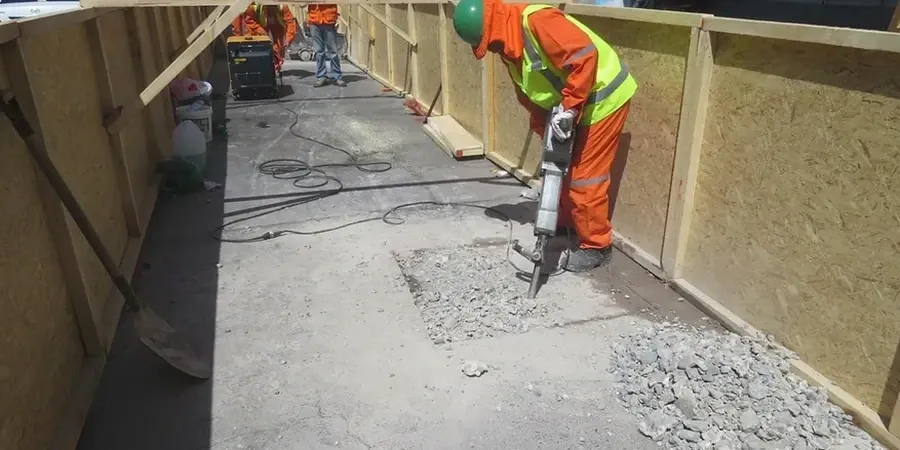
The most expensive mistake a contractor can make in North Las Vegas is assuming the ground is uniform. We have seen projects where crews hit a buried caliche lens at three feet, and suddenly the excavator bucket isn't enough—the schedule slips, the rental meter keeps running. Our exploratory test pit approach eliminates that uncertainty by opening a direct window into the subsurface. Instead of inferring conditions from a core sample, we expose a vertical face where you can see layering, moisture, and cementation with your own eyes. In a city built on alluvial fans spilling from the Sheep Range, soil changes every few hundred feet. The grain size analysis we run on samples from each pit confirms whether you are dealing with poorly graded sand or a gap-graded mix that will compact differently. We also pair findings with Atterberg limits when we encounter fine-grained seams, giving the engineer the full plasticity picture before a foundation design goes final.
A three-foot-deep test pit can reveal more about constructability than a thirty-foot boring—because seeing the soil fabric in place changes the conversation between the contractor and the geotechnical engineer.
Our approach and scope
North Las Vegas sits at roughly 2,200 feet elevation, where summer surface temperatures exceed 140°F and winter nights dip below freezing—a thermal swing that cracks weak concrete and heaves moisture-sensitive soils. Our test pit methodology accounts for this desert climate from the start: we log the natural moisture content at multiple depths because what looks dry on the surface often hides perched water from infrequent but intense flash-flood events. Each pit gets logged under ASTM D2487 visual-manual classification, photographed with scale, and sampled at every stratum change. When the pit reveals cemented sands typical of the Las Vegas Formation, we measure the degree of induration directly—something a drill rig alone cannot quantify. The report includes pit location coordinates tied to site benchmarks, a stratigraphic column drawn to scale, and field density measurements where compaction verification matters. Contractors working near the northern edge of the valley, closer to the Apex industrial area, frequently encounter interbedded gravels and clays that make excavation planning tricky; our pit logs highlight these transitions before the backhoe operator discovers them.
Site-specific factors
North Las Vegas added over 15,000 new residents between 2020 and 2023, pushing residential development further into the northern basin where soil conditions become less predictable. The 1992 Landers earthquake sequence—felt strongly across the valley—serves as a reminder that Nevada is seismically active, and loose granular soils at depth can densify under shaking. A test pit alone will not answer the liquefaction question, but it gives the first reliable look at the upper soil profile: is there a cap of cemented material over loose sand? Is the fill from a previous grading operation undocumented? We encountered one site near the Aliante master-planned community where a test pit exposed old construction debris buried under six inches of imported fill—a condition that would have gone undetected by a standard boring program. When the pit log flags these hazards, we coordinate additional testing through CPT soundings to profile deeper layers without disturbing the soil fabric, or recommend vibrocompaction if the loose zone extends below the planned footing elevation.
Standards used
ASTM D2487 – Standard Practice for Classification of Soils for Engineering Purposes (Unified Soil Classification System), ASTM D1586 – Standard Test Method for Standard Penetration Test (SPT) and Split-Barrel Sampling of Soils, IBC 2024 – International Building Code, Chapter 18: Soils and Foundations, ASCE 7-22 – Minimum Design Loads and Associated Criteria for Buildings and Other Structures, OSHA 1926 Subpart P – Excavation and Trenching Safety Requirements
Common questions
What does an exploratory test pit cost for a typical residential lot in North Las Vegas?
For a standard single-lot investigation with two to three pits excavated to depths of 8 to 12 feet, the cost typically falls between US$520 and US$870. The final number depends on access for the excavator, the number of pits required by the geotechnical engineer, and whether we need to bring in a spotter for utility clearance on tighter urban lots. This range includes the field log, photography, and coordination with the lab for follow-up testing.
How deep can you go with a test pit in the cemented soils common around North Las Vegas?
With a standard rubber-tire backhoe we can reach 14 feet in most of the valley-fill deposits, but the practical limit depends on the degree of caliche cementation. When the caliche layer is massive and thicker than about two feet, we switch to a larger excavator with a ripper tooth or recommend supplementing the program with SPT drilling to get below the hardpan. Safety is the governing factor; any pit deeper than five feet must comply with OSHA sloping or shoring requirements.
How quickly can you turn around a test pit report after excavation?
A field log with photographs and initial classification is typically available within 24 hours of completing the pits. If laboratory testing—grain size, Atterberg limits, or moisture-density relationships—is required, the full report with engineering recommendations is delivered in five to seven business days. We can expedite the lab queue for projects facing a tight grading schedule.