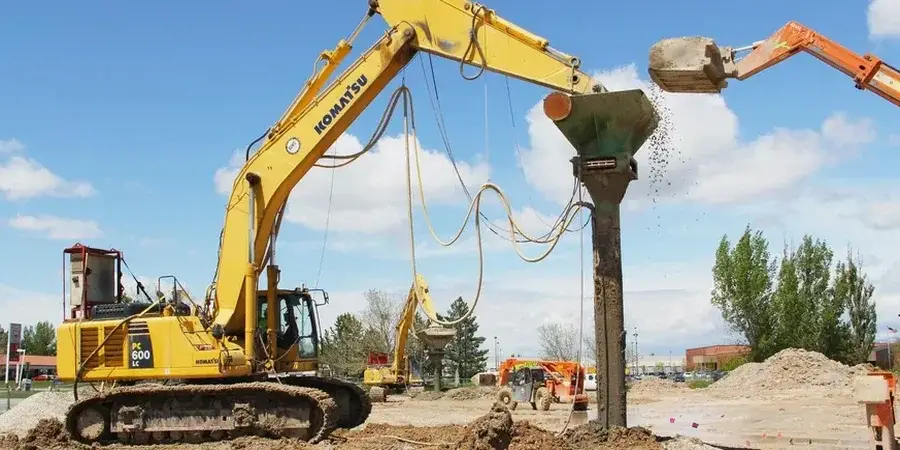
The vibrator rig rumbles across a North Las Vegas lot, its extended depth vibrator lance penetrating granular alluvium with a steady 1800 rpm frequency. In this part of Clark County, where subsurface conditions often alternate between clean sands and silty lenses from ancient Mojave Desert washes, vibrocompaction design transforms loose, compressible soil into a dense bearing stratum. Each probe point follows a staggered grid calibrated to the gradation of local Las Vegas Formation deposits. Water jets assist penetration while the vibratory energy rearranges grains into a tighter configuration. The design team adjusts spacing, dwell time, and power based on real-time cone penetration test correlations and grain-size analyses from nearby borings.
For sites underlain by interbedded fines that resist vibratory rearrangement, the design approach shifts to stone columns as an alternative densification strategy, particularly where the target depth exceeds 25 feet and the water table sits within 10 feet of the working grade.
Achieving 80 percent relative density in North Las Vegas alluvial sands typically requires a probe spacing under 8 feet and dwell times calibrated to real-time CPT tip resistance.
Our approach and scope
IBC Section 1805 and ASCE 7-22 Chapter 20 govern the seismic ground motion parameters that feed into any North Las Vegas vibrocompaction design. The city sits within a region where the mapped short-period spectral acceleration can exceed 0.6g, making post-improvement relative density targets of 70 to 85 percent a standard specification. Our laboratory, accredited to ISO/IEC 17025:2017 through A2LA, runs ASTM D4253 and D4254 maximum and minimum index density tests on bulk samples from each exploratory boring. These values anchor the design calculations. The field program then verifies densification through SPT N-values per ASTM D1586, typically requiring a post-treatment N1,60 exceeding 25 blows per foot in the upper 30 feet. The triangular probe pattern, often spaced at 6 to 8 feet on center, is refined after the first test panel to account for local variations in the caliche-cemented horizons that sporadically appear across the northern Las Vegas basin.
Common questions
What soil types in North Las Vegas are suitable for vibrocompaction?
Vibrocompaction works best in clean granular soils with less than 12 to 15 percent fines passing the No. 200 sieve. Much of North Las Vegas is underlain by alluvial sands and gravels from the Las Vegas Formation that fall within this range. Where silt content exceeds 15 percent, the vibratory energy damps out too quickly, and stone columns or rigid inclusions become more effective alternatives.
How much does a vibrocompaction design and treatment program cost in North Las Vegas?
A typical vibrocompaction design package with pre-treatment borings, laboratory index testing, and post-treatment verification runs between US$1,640 and US$4,820 for the geotechnical engineering scope. The field treatment cost is separate and depends on the treatment area, depth, and probe grid density.
How long does the design phase take before field work begins?
From mobilization of the drill rig for pre-treatment borings through laboratory testing and final design report, plan on 10 to 14 business days. The test panel installation and evaluation adds another 2 to 3 days in the field before the production grid can be released.
What acceptance criteria do you use to verify the ground improvement?
We target a post-treatment relative density of 70 to 85 percent, confirmed by SPT N1,60 values of at least 25 blows per foot or CPT tip resistance exceeding 1500 psi in the treated depth interval. The specific criteria are set during design based on the project's settlement tolerance and the seismic site class per ASCE 7-22 Chapter 20.