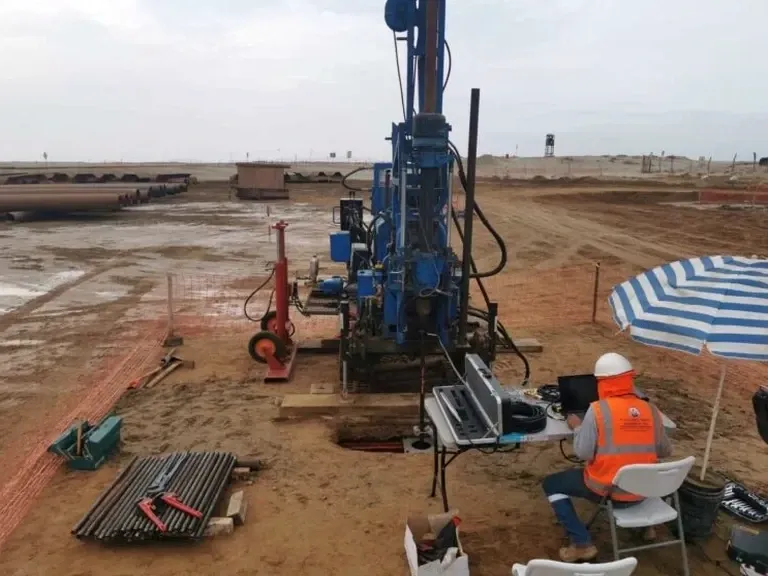
A lot of crews in North Las Vegas still rely on SPT alone and end up missing thin loose layers at 15 feet that kill bearing capacity. In the Vegas basin, interbedded clays and silts shift over just a few hundred yards. A CPT rig pushes through that stratigraphy continuously, recording tip resistance and sleeve friction every centimeter. We run it straight from the truck on Cheyenne Avenue job sites or out in the Aliante master-planned expansions, getting 60 meters of profile in under two hours. The data feeds straight into liquefaction triggering analysis, no lab delays. When the upper 30 feet show the kind of fine-grained matrix common north of the Spaghetti Bowl, we correlate with grain size lab runs to lock the soil behavior type chart and avoid misclassifying silty sands as clean sand. It is the only way to catch thin seams before the excavator opens the cut.
One CPT push replaces six borings in terms of stratigraphic resolution. You see every lens, not just the 5-foot splits.
Our approach and scope
North Las Vegas sits at roughly 2,200 feet elevation on a deep alluvial basin, with groundwater typically below 80 feet in the northwest but much shallower near the Las Vegas Wash. That hydrogeology matters for CPT work. Our 20-ton rig pushes a standard 10 cm² cone with a 60-degree apex, measuring qc, fs, and u2 pore pressure at 2 cm intervals. We log friction ratios on the fly and flag anything above 3% for Atterberg follow-up. In the caliche-cemented layers common east of I-15, we switch to a high-capacity cone and watch the sleeve stress spike, then correlate with Atterberg limits to confirm whether the cementation is true carbonate or just desiccation crust. The ASTM D5778 standard governs every push, and we calibrate the load cell and pore transducer at the start and end of each day. Data comes out as a clean PDF log with normalized soil behavior type, undrained shear strength, and equivalent SPT N60, ready for the structural engineer's L-Pile or Settle3 model.
Common questions
How much does CPT testing cost in North Las Vegas?
CPT pushes in the Las Vegas basin typically run between US$160 and US$280 per meter, depending on depth, cone type, and whether you need dissipation tests or SCPT shear wave measurements. A standard 20-meter profile with piezocone falls in the lower end of that range. We provide a firm quote after reviewing the site location, target depth, and number of pushes required.
How deep can you push a CPT in North Las Vegas soils?
Our 20-ton truck-mounted rig reaches 60 meters (200 feet) in the uncemented alluvial fill that dominates the basin. In zones with thick caliche hardpan, refusal can occur shallower. We monitor push force and inclination in real time and will not risk cone damage by forcing through refusal layers.
What is the difference between CPT and SPT for my project?
SPT gives you a disturbed sample and an N-value every 5 feet. CPT gives you continuous tip resistance, sleeve friction, and pore pressure every 2 centimeters, with no disturbance. For the interbedded silts and clays typical north of the 215 Beltway, CPT catches thin soft layers that SPT spacing misses entirely. The trade-off is that CPT does not recover a physical sample for visual classification.
Do you need a separate boring to calibrate CPT data?
Not always, but a single calibration boring with sampling at key depths improves confidence. We use the soil behavior type chart (Robertson, 2016) to classify from qc and Rf, and a few Atterberg and grain size lab tests from a nearby SPT boring or test pit let us anchor the chart to actual material behavior for the specific basin stratigraphy.