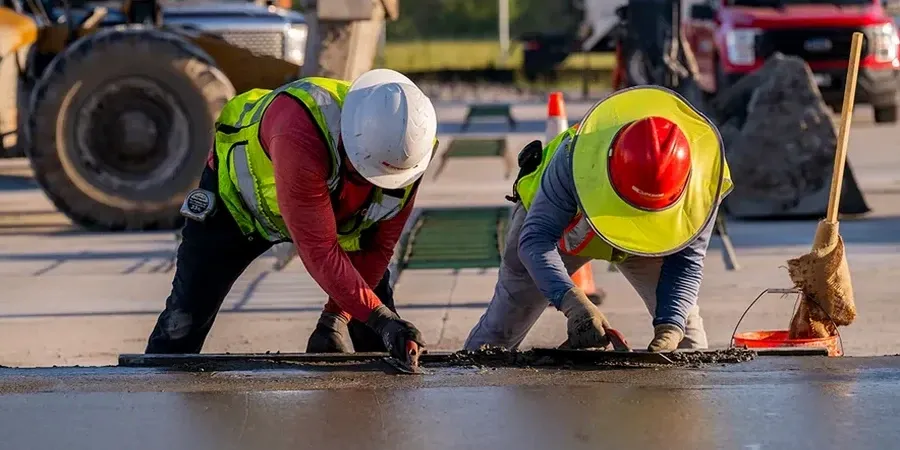
The 2024 International Building Code sets clear expectations for pavement performance, but in North Las Vegas those baseline requirements are just the starting point. With summer ground temperatures exceeding 140°F and underlying soils that shift dramatically with moisture, a standard rigid pavement section rarely survives its first monsoon season intact. We see it in industrial parks near the Speedway and residential streets in Aliante: curling stresses from the thermal gradient between the slab top and bottom create hidden fatigue long before visible cracking appears. The silt and clay deposits common across the northern valley demand subgrade treatment that goes beyond what a textbook design would prescribe. Our team applies the mechanistic-empirical framework from AASHTOWare Pavement ME, calibrated with local climate data from the North Las Vegas Airport station, to produce rigid pavement designs that hold up under both the sun and the occasional cloudburst. Before finalizing a concrete section, we often run a CBR road test on the treated subgrade to verify that the stiffness assumptions in the model match field reality.
A rigid pavement in North Las Vegas fails from the bottom up. If the subgrade is not uniform, the slab cannot be uniform either.
Site-specific factors
A deceptive condition we encounter repeatedly in North Las Vegas is the presence of moisture-stabilized clay beneath older pavement sections. The desert surface looks dry, so contractors assume the subgrade is at equilibrium. But once a rigid slab is placed and seals the ground, the moisture trapped underneath has nowhere to go. It migrates toward the cooler slab edges, softens the support at the joints, and initiates pumping under traffic. We have measured k-values dropping from 150 pci to below 80 pci within 18 months of construction. The fix is not thicker concrete. It is drainage. Edge drains and daylighted permeable bases are not optional here. The Clark County Regional Flood Control District also requires positive drainage for pavements in Zone A floodplains, which cover significant portions of North Las Vegas. A rigid pavement design that ignores the 100-year flood elevation risks both structural failure and permit rejection. We cross-check finished floor elevations against the effective FEMA FIRM panel before locking in any rigid pavement section.
Standards used
IBC 2024 Chapter 18 (Soils and Foundations), ASCE 7-22 (Minimum Design Loads), ASTM C78 / C78M (Flexural Strength of Concrete), ASTM D2487 (Unified Soil Classification System), ACI 360R-10 (Guide to Design of Slabs-on-Ground), AASHTO Guide for Design of Pavement Structures 1993 (supplemented by MEPDG)
Common questions
What is the typical cost range for a rigid pavement design in North Las Vegas?
Design fees for a rigid pavement project in North Las Vegas typically fall between US$1,970 and US$5,900, depending on the total paved area, the number of soil borings required, and the complexity of the jointing plan. Industrial facilities with heavy forklift traffic or sites within a FEMA flood zone tend toward the upper end of that range.
Why does rigid pavement crack so quickly in the North Las Vegas heat?
Thermal curling is the primary culprit. During summer afternoons, the top of the slab can be 30°F hotter than the bottom. This temperature differential causes the slab edges to lift, concentrating stress at the center. When a heavy truck passes over a curled slab, the tensile stress at the bottom can exceed the concrete's flexural capacity. Tightening joint spacing and using a low-CTE aggregate both help mitigate this mechanism.
Do I need a geotechnical investigation before rigid pavement design?
Absolutely. North Las Vegas soils are too variable to rely on presumptive values. A proper investigation identifies the expansive clay zones, determines the depth to caliche, and provides the k-value needed for slab thickness calculations. Without it, you are designing blind.
Can fiber reinforcement replace dowel bars at joints?
Not for the heavy truck traffic common in North Las Vegas logistics areas. Steel fibers improve post-crack behavior and can tighten joint openings slightly, but they do not transfer shear loads across a contraction joint the way a properly sized dowel basket does. For industrial pavements, we specify dowels even when macro-synthetic fibers are used for crack control.