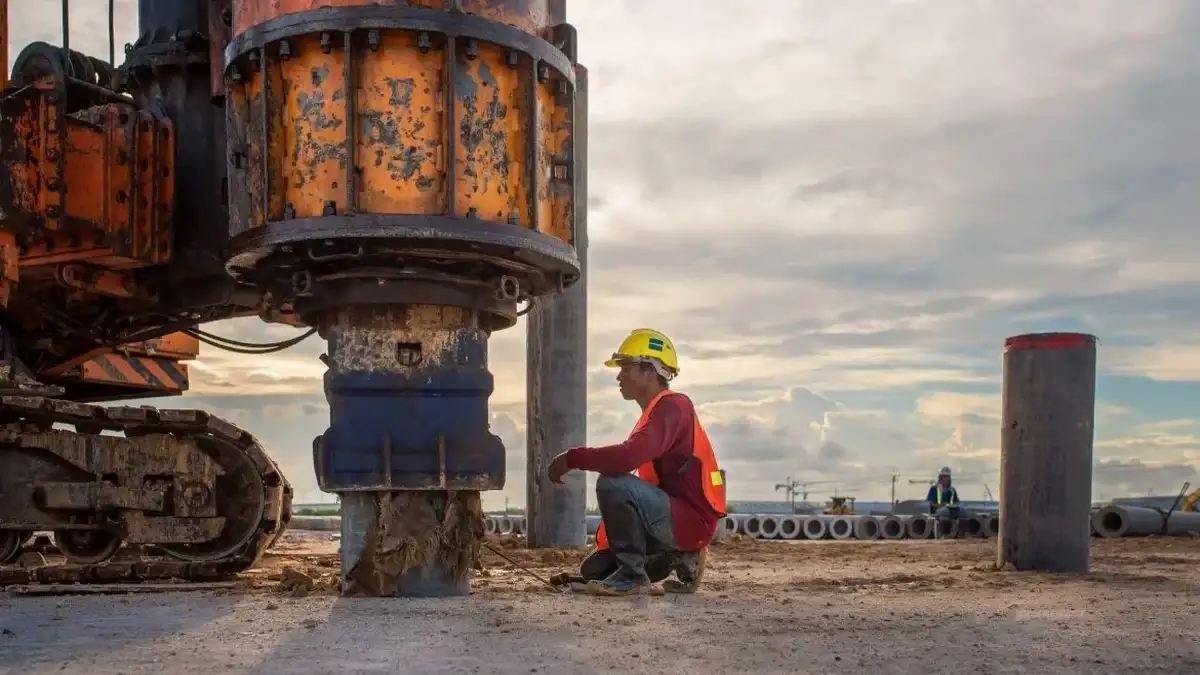
The bedrock in North Las Vegas sits beneath hundreds of feet of cemented alluvium and caliche. That hardpan layer speeds up shear waves, but basin-edge effects near the Las Vegas Valley Shear Zone can drop Vs30 values fast. A lot of sites look like stiff soil on the surface and still classify as Site D under IBC. We run active-source MASW surveys with 24-channel arrays to get the real velocity profile down to 30 meters. No boreholes. No guesswork. Just a clean dispersion curve that tells you if your foundation loads will amplify during a seismic event. For deeper stratigraphy or a direct SPT blow count, we often pair this with an SPT drilling campaign to calibrate the geophysical data against actual soil samples.
Vs30 is not a material property. It's a travel-time average. A thin hardpan layer at 2 meters can mask a soft basin fill below.
Our approach and scope
The 1990s housing boom pushed North Las Vegas into the deep alluvial fans of the Sheep Range. Early builders assumed uniform Site C conditions. They were wrong. Today's IBC 2024 Chapter 16 is explicit: Vs30 must be measured, not inferred from blow counts alone, where the soil profile is highly variable. Our crew runs a linear geophone spread with a 10-lb sledge source. We capture fundamental-mode Rayleigh wave data, invert it with a genetic algorithm, and deliver a 1D shear wave velocity profile. The report includes Vs30, site class per ASCE 7-22, and the seismic coefficient for your structural engineer. The setup takes about 45 minutes on a pad-ready lot. We avoid the caliche chatter that screws up refraction results by modeling the full frequency spectrum. Turnaround is tight.
Common questions
How much does a MASW survey cost in North Las Vegas?
A standard active-source MASW line for Vs30 classification in North Las Vegas runs US$1,510 to US$2,730. The exact number depends on site access, array length needed to hit 30 meters, and whether we need to add a passive survey for deeper profiling. A flat, graded lot with easy truck access costs less than a raw desert parcel with heavy brush.
Does IBC accept MASW instead of a downhole seismic test?
Yes. IBC 2024 Section 1613.2 accepts surface wave methods like MASW to determine Vs30 and site class, provided the geophysics are performed by a qualified firm and the dispersion curve is properly inverted. We document the inversion parameters and misfit error in every report so the structural reviewer can verify the result.
How long does the field work take on a typical North Las Vegas lot?
A single active-source MASW line takes about 45 to 60 minutes of acquisition time. We arrive early to avoid wind noise. Setup and breakdown add another 30 minutes. Most residential and commercial lots are done within a two-hour window. You receive the Vs30 value and site class within two business days.
Can MASW work through caliche and hard desert crust?
It can, but the inversion needs careful handling. A thin, high-velocity caliche layer creates a strong velocity inversion that can fool an unconstrained inversion algorithm. We run a passive MASW array alongside the active line to capture longer wavelengths and constrain the deeper model. This dual approach gives us a reliable Vs30 even when the near-surface is cemented.