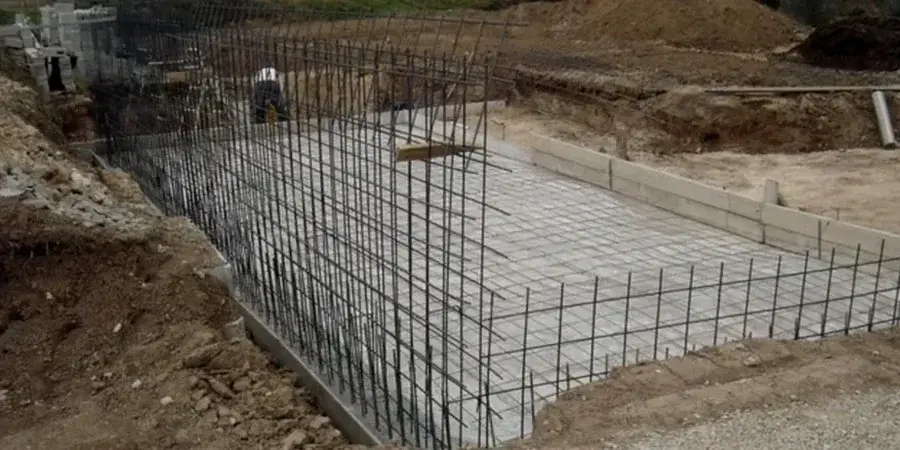
North Las Vegas grew from a railroad stop into one of Nevada's fastest-expanding suburban grids, pushing residential and logistics construction deep into the northern basin. That expansion lands on a complex soil stack: thin desert pavement overlying fine-grained alluvium, cemented caliche lenses, and pockets of wind-deposited silt that collapse under moisture. Shallow foundation design here cannot rely on textbook presumptive values. The combination of low natural moisture content and sudden stormwater infiltration—common during monsoon pulses that funnel off the Sheep Range—creates a geotechnical environment where differential movement can show up within a single building footprint. Our team approaches every shallow foundation design with a site-specific bearing capacity analysis tied to ASTM D1586 subsurface data and the load combinations required by ASCE 7 for this seismic region, ensuring that spread footings and mat slabs perform predictably across the variable basin stratigraphy.
Caliche in North Las Vegas can push allowable bearing pressure above 4,000 psf—until a perched water lens from landscape irrigation halves that capacity in one season.
Site-specific factors
The desert climate of North Las Vegas masks the biggest risk to shallow foundation design: a moisture regime that swings from near-zero to saturation in hours. Summer monsoons channel runoff from the Las Vegas Range across alluvial fans, ponding water against foundation edges where it percolates through poorly compacted backfill and triggers collapse settlement in silty lenses. Even more insidious is the long-term effect of landscape irrigation in built-out subdivisions, where a chronic rise in sub-slab moisture softens the load-bearing caliche crust that originally provided high bearing values. We address this by pairing foundation recommendations with a drainage and moisture-control specification: positive site grading away from footings, rigid perimeter moisture barriers extending 24 inches beyond the drip line, and imported select fill compacted to 95% of modified Proctor maximum dry density. When the soil profile reveals expansive clay seams with plasticity indices above 25, we specify deepened footings or post-tensioned slab systems that distribute heave forces without overstressing the structural frame.
Standards used
IBC 2024 (International Building Code) – Chapter 18 Soils and Foundations, ASCE/SEI 7-22 Minimum Design Loads and Associated Criteria for Buildings, ASTM D1586 Standard Test Method for Standard Penetration Test (SPT), ASTM D2487 Standard Practice for Classification of Soils for Engineering Purposes, ASTM D1195 Standard Test Method for Repetitive Static Plate Load Tests, ACI 318-19 Building Code Requirements for Structural Concrete
Common questions
How much does a shallow foundation design package cost for a typical North Las Vegas commercial lot?
For a standard commercial pad under 5,000 square feet in North Las Vegas, a complete shallow foundation design package—including site investigation, bearing capacity analysis, and stamped foundation plans—typically falls in the US$2,110 to US$2,910 range. The final cost depends on the number of exploratory borings required, the complexity of the soil profile encountered, and whether a plate load test is needed to confirm bearing values in caliche-bearing strata.
What is caliche and how does it affect shallow foundation design in North Las Vegas?
Caliche is a naturally cemented layer of calcium carbonate that forms in arid soils through evaporation-driven precipitation. In North Las Vegas, caliche typically appears between 18 and 48 inches below grade as irregular lenses or continuous hardpan. It can provide excellent bearing capacity—often exceeding 4,000 psf—but its thickness and lateral continuity are unpredictable. Foundation design must verify that the caliche layer is thick enough to distribute load without punching through into softer underlying silts, which is why we often combine SPT refusal data with a plate load test at footing elevation.
Do you handle the special inspection requirements for foundations under IBC Chapter 17?
Yes. Our field engineers perform the required special inspections for shallow foundations, including verification of bearing stratum at footing bottom, compaction testing of subgrade and backfill, and documentation of reinforcement placement prior to concrete placement. We issue the final special inspection report that the building official requires before signing off on the foundation phase of construction in the City of North Las Vegas.
How do you address collapsible soils during shallow foundation design?
Collapsible soils—typically low-density silty sands and silts found in alluvial fan deposits across the northern Las Vegas Valley—are identified through laboratory collapse potential testing on undisturbed samples. Our design response depends on the collapse strain measured: for mild collapse potential, we specify pre-wetting and recompaction of the upper bearing zone; for moderate to severe collapse potential, we prescribe removal and replacement with engineered fill compacted to 95% of modified Proctor density, plus deepened footings that bear below the zone of moisture fluctuation.
What seismic provisions apply to shallow foundations in North Las Vegas?
North Las Vegas falls within a seismically active region per the USGS National Seismic Hazard Model, and shallow foundation design must comply with ASCE 7-22 seismic provisions. This includes site class determination (typically Class C or D for basin soils), consideration of liquefaction potential in saturated granular layers, and foundation tie-beam requirements for structures assigned to Seismic Design Category D or higher. Our designs incorporate these lateral force-resisting system connections as part of the foundation package.