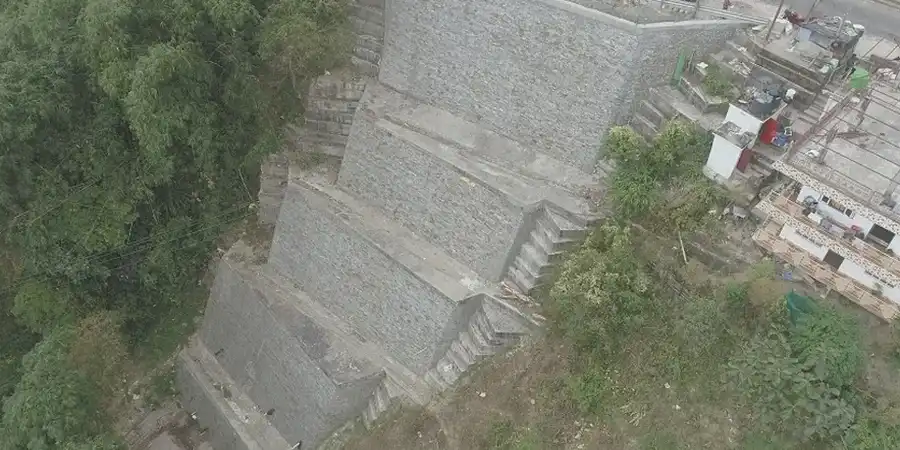
Around North Las Vegas, the transition from flat desert floor to the alluvial fans that lap at the edges of the Sheep Range creates deceptively complex terrain. We have walked slopes that looked sound in summer, only to find them ravaged after a single monsoon downpour. The Mojave Desert's arid veneer masks soils that can lose significant strength when water finally infiltrates. A slope stability analysis here is not a routine check; it requires understanding the interplay between heavily desiccated surficial crust, underlying weakly cemented sands, and the flashy hydrology of the Las Vegas Wash. We integrate this local geomorphology with seismic refraction surveys to map the bedrock profile, because guessing the depth to competent material out here will catch up with you.
Desert slopes fail differently; suction loss from a single monsoon can drop the safety factor below 1.0 before you even notice the crack.
Site-specific factors
We set up the core logging station right on site, splitting open Shelby tube samples from the slope face to check for the fine gypsum and calcite stringers that so often define the weak planes out here. These evaporite layers, common in the Las Vegas Formation soils, can dissolve or soften with water contact, creating a slip surface that standard lab tests might miss if the sample dries out. The physical risk in North Las Vegas is frequently tied to unplanned water: a broken irrigation line saturating the toe of a fill slope, or a retention basin leaking into a cut. Our analysis explicitly models these transient seepage scenarios using finite-element seepage coupled with slope stability software, ensuring the design isn't just safe on paper but survives the real-world operational chaos of a fast-growing desert city.
Common questions
What is the typical cost range for a slope stability analysis in North Las Vegas?
For a single residential or light commercial slope, the analysis typically ranges from $1,290 to $3,700. The final cost depends heavily on the slope height, the complexity of the soil stratigraphy encountered, and whether dynamic (seismic) analysis is required by the local building department. A site with multiple benched cuts or evidence of past instability will fall toward the upper end due to the additional laboratory testing and modeling iterations.
How does the Caliche layer affect slope stability in this area?
The caliche (calcrete) cap common across North Las Vegas creates a strong but brittle surface layer. The risk lies beneath it: the caliche can bridge over weaker, loose silty sands. If the toe of the slope is cut through the caliche, or if water penetrates through cracks and softens the underlying material, a sudden block failure can occur. Our analysis always investigates the potential for a two-layer failure mechanism, modeling the caliche as a rigid block over a softer foundation.
What factor of safety do you target for permanent cut slopes?
For static, long-term conditions, we target a minimum factor of safety of 1.5, consistent with IBC 2024 and standard geotechnical practice in Clark County. For the pseudo-static seismic condition, we use a minimum factor of safety of 1.1. However, based on the consequences of failure—for example, if the slope is above a residential structure—we often recommend a higher seismic factor of safety, moving to 1.2 or more, to limit permanent seismic displacement to acceptable levels per a Newmark sliding block analysis.
Do I need a slope stability analysis for a retaining wall under 4 feet?
While IBC typically exempts walls under 4 feet from requiring an engineered design, the global stability of the slope behind and below the wall is a separate concern. We have seen short walls in North Las Vegas fail because the slope they were built on was unstable. If the wall is constructed on a fill slope or near a descending slope, a global slope stability analysis is necessary, regardless of the wall height, to ensure the entire mass isn't susceptible to a deep-seated failure.