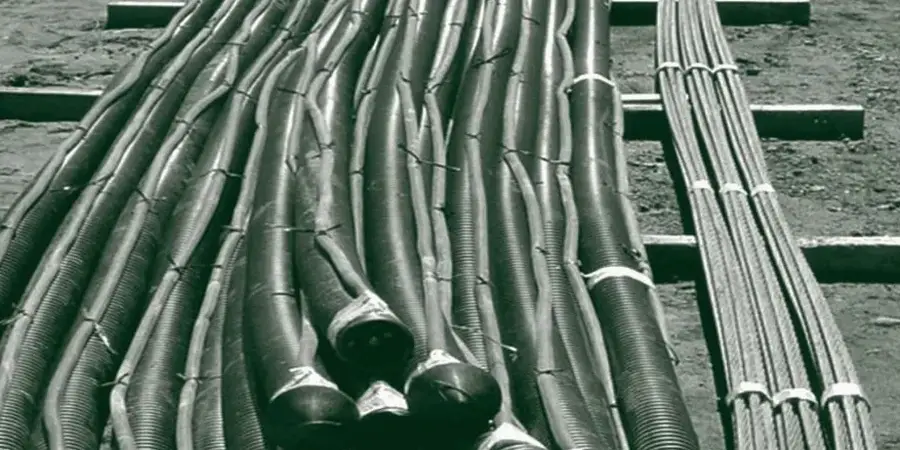
We evaluated a 40-foot excavation off Losee Road last summer where the contractor planned a standard soldier pile wall with tiebacks. The top 15 feet consisted of loose desert alluvium, but the lower strata transitioned into the caliche-rich gravels typical of the Las Vegas Valley. Conventional passive resistance assumptions for the deadman anchors failed to account for the brittle behavior of the cemented layer. By switching to a bonded active anchor design and increasing the unbonded length through the caliche, we achieved the required load capacity without overstressing the grout body. This is the kind of local stratigraphy that design tables in textbooks don't capture. In North Las Vegas, anchor selection isn't just about computing pullout resistance; it's about knowing where the hardpan sits and how it behaves under sustained tension. We routinely combine anchor design with CPT testing to map the exact depth and thickness of cemented layers before finalizing bond lengths, and we use retaining wall analysis to verify global stability when multiple rows of anchors are required.
In North Las Vegas, the difference between a successful anchor and a creeping failure often comes down to knowing the caliche boundary depth within six inches.
Site-specific factors
The Mojave Desert soils in North Las Vegas are characterized by Holocene-age alluvial deposits with variable cementation. Caliche layers, formed by calcium carbonate precipitation over thousands of years, can reach compressive strengths exceeding 1,000 psi in their cemented state, yet fracture with minimal tensile strain. A passive anchor relying on the native soil's shear strength can experience sudden loss of capacity if the caliche cracks under load, transferring all tension to the grout column. We've documented load test failures where a passive system lost 40 percent of its capacity within 72 hours of proof testing, simply because the cemented soil relaxed. Active anchors mitigate this by maintaining constant tension regardless of soil creep, but they demand rigorous lock-off procedures and periodic re-stressing if the anchor is accessible. Blowout risk is another concern in North Las Vegas: the shallow groundwater in some basin areas, combined with high grout injection pressures, can fracture the overburden and daylight at the surface. We always perform a blowout analysis using the weight of the overlying soil column before specifying injection pressures.
Common questions
What is the difference between active and passive anchors?
Active anchors are post-tensioned after grouting to apply a predetermined force to the structure, keeping the soil mass in compression. Passive anchors develop resistance only when the soil begins to move; they rely on the ground's shear strength and are not pre-loaded. In North Las Vegas, where cemented soils can relax suddenly, active anchors provide more reliable long-term performance.
How deep do anchors need to go in North Las Vegas soils?
Bond zone depth depends on the caliche horizon. In areas like Aliante, we often set the bond zone between 20 and 35 feet below grade, below the loose alluvial cover. Where finer silts dominate, the bond zone may extend to 50 feet or more to reach competent material. A CPT profile is the fastest way to determine the exact depth for your site.
What does anchor design and installation cost in North Las Vegas?
Anchor design and testing typically ranges from US$910 to US$4,120, depending on the number of anchors, testing requirements, and whether we're dealing with active or passive systems. A single deep anchor with full proof testing will be at the higher end, while a simpler deadman anchor design falls at the lower end.
Are there special corrosion concerns for anchors in the desert?
Yes. The alkaline soils in the Las Vegas Valley, combined with occasional irrigation runoff, create a moderately corrosive environment. We specify Class II corrosion protection per PTI standards (corrugated sheathing with grout cover) for permanent anchors. Temporary anchors used during construction may use Class I protection if they'll be decommissioned within 24 months.