← Home · Laboratory

Laboratory CBR Test in North Las Vegas: Subgrade Strength Assessment

Together, we solve the challenges of tomorrow.

LEARN MORE →

North Las Vegas sits at 1,841 feet elevation with annual rainfall barely clearing 4 inches. That arid climate creates unique subgrade conditions—hard-packed silty sands and occasional caliche layers that fool the eye. A soil that looks solid during summer grading can lose significant strength under moisture fluctuation. The laboratory CBR test cuts through that uncertainty. We run soaked and unsoaked specimens per ASTM D1883 to determine the California Bearing Ratio your pavement design actually needs. Our team handles sample preparation and testing at our accredited lab. You get a report with CBR values at 0.1-inch and 0.2-inch penetration. That data feeds directly into the AASHTO pavement design equation. No guesswork. Just numbers that hold up under traffic loading. For projects needing subgrade evaluation before pavement design, the CBR test provides the empirical foundation engineers trust.

A soaked CBR value of 6 versus 12 can double your required base thickness. One test changes the entire pavement section cost.
Our approach and scope

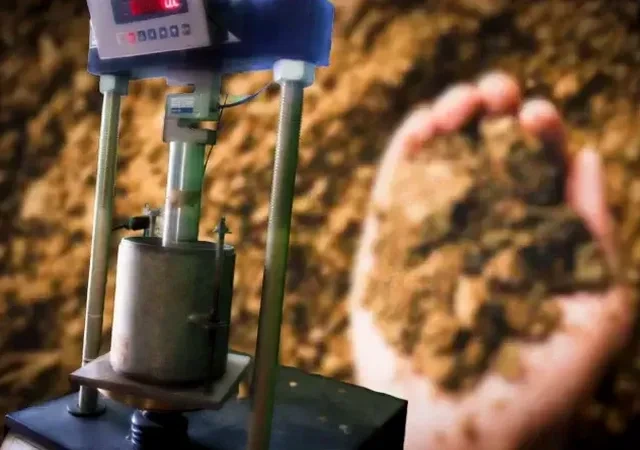
North Las Vegas soils often surprise contractors. A site near the Aliante master-planned community might test at CBR 3 on the surface but jump to CBR 25 just 18 inches down into the caliche. That variability matters. The laboratory CBR test measures load penetration on a compacted specimen. We use a standardized piston at 0.05 inches per minute. The result is a percentage comparing your soil's resistance to a standard crushed California limestone. Soaked CBR simulates worst-case moisture conditions. For pavement in the I-15 corridor expansion areas, soaked values often control the design section. We run the test at modified Proctor density to match field compaction specs. Each specimen gets precise moisture conditioning. The final report includes the load-penetration curve and the corrected CBR value.
Laboratory CBR Test in North Las Vegas: Subgrade Strength Assessment
Technical reference image — North Las Vegas

Site-specific factors

A site near Craig Ranch on young alluvial deposits behaves differently than one up against the Sheep Range foothills with older cemented soils. We have seen projects where assumed CBR values from a desk study missed the mark by 40 percent. The consequence shows up fast. Under-designed pavement ravels within two seasons. Over-designed sections waste aggregate on a subgrade that did not need it. The laboratory CBR test eliminates that risk. It tells you exactly what your soil can carry. In North Las Vegas, the difference between a CBR of 5 and a CBR of 15 is often just a few feet of depth. You cannot guess that. You have to test it. Skipping the lab work means accepting liability for pavement performance you never verified.

Need a geotechnical assessment?

Reply within 24h.

Email: info@geotechnicalengineering1.com

Technical data

ParameterTypical value
Test StandardASTM D1883
Specimen CompactionModified Proctor (ASTM D1557)
Penetration Rate0.05 in/min
Soaking Period96 hours
Surcharge Weight10 lb minimum
Penetration ReadingsAt 0.1 in and 0.2 in
Reported ValueCBR percentage, corrected

Complementary services

01

Soaked and Unsoaked CBR Testing

We run specimens at optimum moisture and after 96-hour soaking. The soaked value generally governs pavement design in North Las Vegas where post-construction moisture equilibrium can differ significantly from dry construction conditions.

02

Subgrade and Base Material Evaluation

Beyond the CBR number, we provide material classification per ASTM D2487 and compaction characteristics per ASTM D1557. This gives your pavement engineer the complete soil profile needed for AASHTO flexible pavement design.

Standards used

ASTM D1883 - Standard Test Method for California Bearing Ratio (CBR) of Laboratory-Compacted Soils, ASTM D1557 - Standard Test Methods for Laboratory Compaction Characteristics of Soil Using Modified Effort, AASHTO T 193 - Standard Method of Test for The California Bearing Ratio, ASTM D2487 - Standard Practice for Classification of Soils for Engineering Purposes

Common questions

What does a laboratory CBR test cost in North Las Vegas?

For a standard 3-point CBR test on one soil type (one compaction curve plus three soaked specimens), the typical range is $140 to $210. The exact cost depends on the number of soil types and whether you need both soaked and unsoaked values.

How long does the laboratory CBR test take?

The full soaked CBR procedure requires 4 days minimum. The compaction curve takes one day. Specimen preparation and compaction take another day. The 96-hour soaking period follows. Then we run the penetration test on day four and deliver the report. Unsoaked CBR can be completed in 1-2 days.

What CBR value is acceptable for pavement design in North Las Vegas?

There is no single answer. Local agencies often require a minimum soaked CBR of 3 to 5 for residential streets and 10 to 15 for arterial roads. The required value depends on traffic loading, pavement type, and the design method your engineer uses. We provide the measured values and let your designer make the call.

Location and service area

We serve projects in North Las Vegas and surrounding areas.

View larger map