← Home · Seismic

Base Isolation Seismic Design in North Las Vegas: Site-Specific Solutions

Together, we solve the challenges of tomorrow.

LEARN MORE →

Drive from the deep alluvial fans near Aliante Parkway over to the caliche-rich ground around Craig Ranch, and you're looking at two completely different seismic response profiles. In North Las Vegas, the site class can shift from C to D in less than half a mile, which changes everything when you're sizing lead-rubber or friction pendulum isolators. Our team has pulled Shelby tube samples from silty sands near the Las Vegas Wash that looked solid on the surface but told a different story once we ran the lab consolidation tests. Before locking in the isolation parameters, we often combine field data with a MASW survey to nail down the Vs30 profile, and where the bedrock is deeper than expected, the CPT test helps us map the stratigraphy without missing thin liquefiable lenses that a standard boring might skip.

In North Las Vegas, the difference between a stiff site class C and a softer D profile can double the isolator displacement demand—we verify the Vs30 on every job, no exceptions.

Our approach and scope

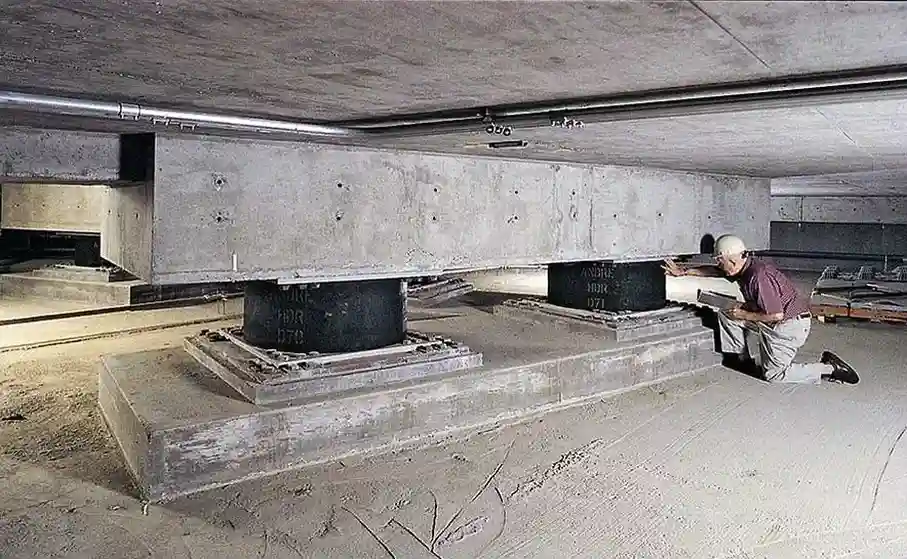
We worked on a four-story medical office building near the VA Hospital where the owner initially wanted a conventional fixed-base frame. The geotech report showed moderately dense sands with occasional gravel lenses, but the spectral accelerations at a 1-second period were higher than the initial DSR assumed. That led us to a hybrid isolation system with sliding bearings and supplemental viscous dampers, reducing the story drift from 1.8% to under 0.6%. In North Las Vegas, you're often dealing with a perched water table in the winter months and bone-dry conditions by July, so the bearing corrosion protection spec matters. We coordinate with the deep excavation crew early because the isolator pits and moat walls need to stay dry during construction, and a single unplanned dewatering shutdown can delay the whole project.
Base Isolation Seismic Design in North Las Vegas: Site-Specific Solutions
Technical reference image — North Las Vegas

Site-specific factors

One thing we see time and again in North Las Vegas is isolator uplift in the corner columns of light-frame structures. The north end of the valley has these stiff caliche crust layers that make the soil look like rock on a blow count, but they fracture under cyclic loading and suddenly you lose the overturning restraint you thought you had. We always run a full nonlinear time-history analysis checking net tensile forces in the bearings, and if the uplift exceeds the isolator capacity, we switch to a tension-restraint design or add supplementary hold-downs. Another local headache is the utility crossings at the moat line—gas and fire lines need flexible couplings rated for the MCE displacement, and that coordination falls through the cracks more often than anyone wants to admit.

Need a geotechnical assessment?

Reply within 24h.

Email: info@geotechnicalengineering1.com

Technical data

ParameterTypical value
Design spectral acceleration SDS (ASCE 7)Site-specific, per Section 21.2
Effective period of isolated structure (TD)2.5 – 4.0 s (typical range)
Isolator lateral displacement (DM)12 – 24 in for MCE level
Equivalent viscous damping ratio15 – 30% (system dependent)
Base shear reduction vs fixed-base50 – 75%
Required moat width (clearance)DM + 20% minimum per IBC
Wind restraint thresholdDesign wind load × 1.2 (service level)

Complementary services

01

Site-Specific Seismic Hazard Analysis

We develop uniform hazard spectra and site response models using North Las Vegas basin effects data, accounting for the deep alluvial fill that amplifies long-period motion.

02

Isolation System Design and Sizing

Selection and nonlinear modeling of lead-rubber, high-damping rubber, or friction pendulum isolators, with full 3D time-history analysis per ASCE 7 Chapter 17.

03

Prototype and Production Testing Oversight

We write the testing protocol, witness the full-scale bearing tests at the manufacturer's lab, and review the hysteresis loops against the design acceptance criteria.

04

Peer Review and Third-Party Verification

Independent technical review of the isolation design package for Clark County building department submittals, including the moat wall detailing and utility interface design.

Standards used

ASCE/SEI 7-22 Minimum Design Loads and Associated Criteria for Buildings and Other Structures, IBC 2021 Chapter 17 Special Inspections and Tests, ASCE/SEI 41-17 Seismic Evaluation and Retrofit of Existing Buildings, ASTM D7408-12 Standard Specification for Elastomeric Seismic Isolation Bearings

Common questions

What is the typical cost range for base isolation design on a building in North Las Vegas?

Based on recent projects in the city, the structural engineering and isolation-specific design fees typically fall between US$3,660 and US$9,630, depending on the building footprint, number of stories, and whether a peer review is required by the jurisdiction. The isolator hardware procurement and testing are separate costs handled directly with the manufacturer.

Does the IBC require time-history analysis for base-isolated buildings in North Las Vegas?

Yes. Under ASCE 7-22 and the IBC 2021, ground-motion time histories scaled to the site-specific spectra are mandatory for isolation system design. The code requires a minimum of eleven pairs of horizontal motions that reflect the magnitude, distance, and source characteristics relevant to the Las Vegas Valley fault system.

How do you handle the stiff caliche layers we have in parts of North Las Vegas?

Caliche can give misleadingly high SPT N-values. We cross-check with shear wave velocity measurements and often run a seismic refraction survey to map the thickness and continuity of the cemented zone. If the caliche is underlain by softer material, we model it as a layered profile and check that the isolator period doesn't shift into resonance with the softer layer below.
Location and service area

We serve projects in North Las Vegas and surrounding areas.

View larger map